
What the BCBSA Analysis Found
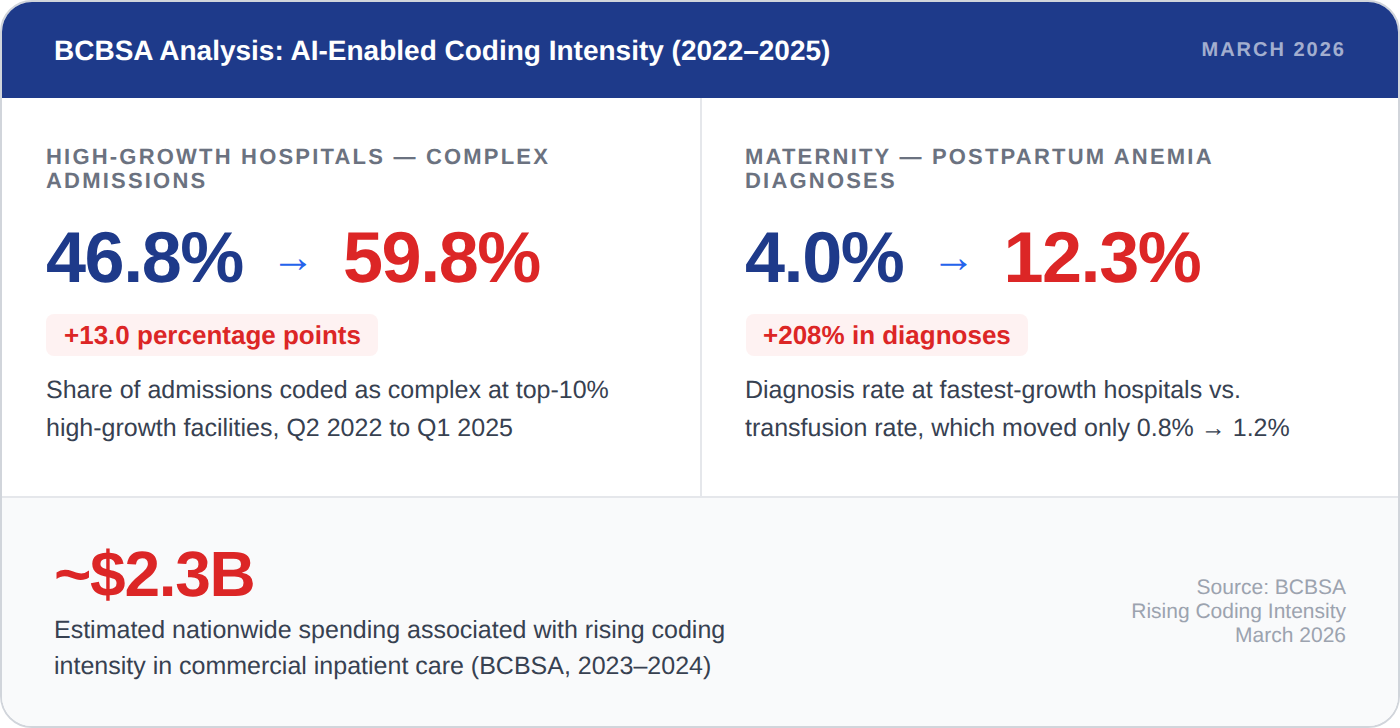
A Blue Cross Blue Shield Association (BCBSA) analysis of commercial inpatient claims found that coding intensity increased sharply at hospitals as AI-enabled documentation and coding tools gained adoption at more than 60 percent of hospital systems. At the top 10 percent of high-growth facilities, the share of admissions coded as complex rose from 46.8 percent in Q2 2022 to 59.8 percent in Q1 2025.
The pattern is visible in individual service lines. In maternity care, hospitals with the fastest growth in coded postpartum anemia saw diagnoses rise from 4.0 percent to 12.3 percent of admissions, a threefold increase, while transfusion rates moved only from 0.8 percent to 1.2 percent over the same period.
BCBSA estimates that rising coding intensity accounted for roughly 20 percent of a 9 percent per-member increase in commercial inpatient costs among participating plans from 2023 to 2024. Its broader analysis estimates approximately $2.3 billion in potentially related spending nationwide.
BCBSA is explicit that these findings are associative, not determinations of clinical appropriateness or provider intent. They do, however, identify a growing affordability and payment-integrity risk that the industry needs to be able to address at scale.
Why It Matters
In diagnosis-related group (DRG) payment models, additional documented complications or comorbidities can move an admission into a higher-paying severity tier. Ambient documentation and coding AI can improve workflow efficiency, but it can also scale the identification of billable diagnoses faster than organizations can demonstrate that coded severity is supported by objective clinical evidence and corresponding care.
The result is a growing trust gap. Payers, employers, patients, and regulators need to distinguish a well-supported diagnosis from a billing claim that is technically documented but insufficiently substantiated by the underlying care record. A disclaimer in the terms of service does not close that gap. Defensible, auditable evidence does.
What Responsible AI-Enabled Documentation Requires
The BCBSA analysis does not establish that every additional diagnosis is unsupported, or that AI caused every higher-cost claim. It does surface a payment-integrity question the industry must be able to answer at scale: as AI increasingly influences clinical documentation, coding, and other high-stakes healthcare workflows, can organizations clearly demonstrate the evidence, authority, review, and accountability behind the resulting decision?
The answer requires more than an audit log. It requires connecting the documented decision to the authoritative source evidence that supports it, the applicable standard or requirement it must satisfy, the verification activity that checked it, and the human review or approval that authorized it, in a form that is defensible to a payer, regulator, or external auditor.
Technically documented
- AI-generated diagnosis entered in the record
- No link to the clinical evidence behind it
- No mapping to the coding standard it must meet
- No record of who reviewed or approved it
Verifiably substantiated
- Source evidence: the objective clinical findings
- Requirement: the standard the diagnosis must satisfy
- Verification: the check that confirmed it
- Human review: who authorized it, and when
The Principle Extends Across High-Liability Workflows
The coding integrity question is specific to billing. The underlying principle is not. Across healthcare, AI is increasingly influencing decisions that depend on the same qualities the BCBSA analysis reveals are missing: clear attribution to authoritative evidence, transparent review, and accountable human oversight.
Provider credentialing is one domain where this challenge is already acute. A credentialing decision that cannot be traced to its primary source evidence, applicable licensure requirement, verification activity, and human authorization creates the same kind of substantiation gap the BCBSA study identifies in coding, with similar consequences for trust, compliance, and payment integrity.
CareLumi is the verification layer for healthcare AI. Its platform connects authoritative source evidence, applicable requirements, verification activity, and human review across provider credentialing and enrollment workflows, creating a defensible record that organizations can present to payers, regulators, and audit bodies. Third-party review timelines, approvals, and regulatory determinations remain outside any platform's control.