
The Five Incidents
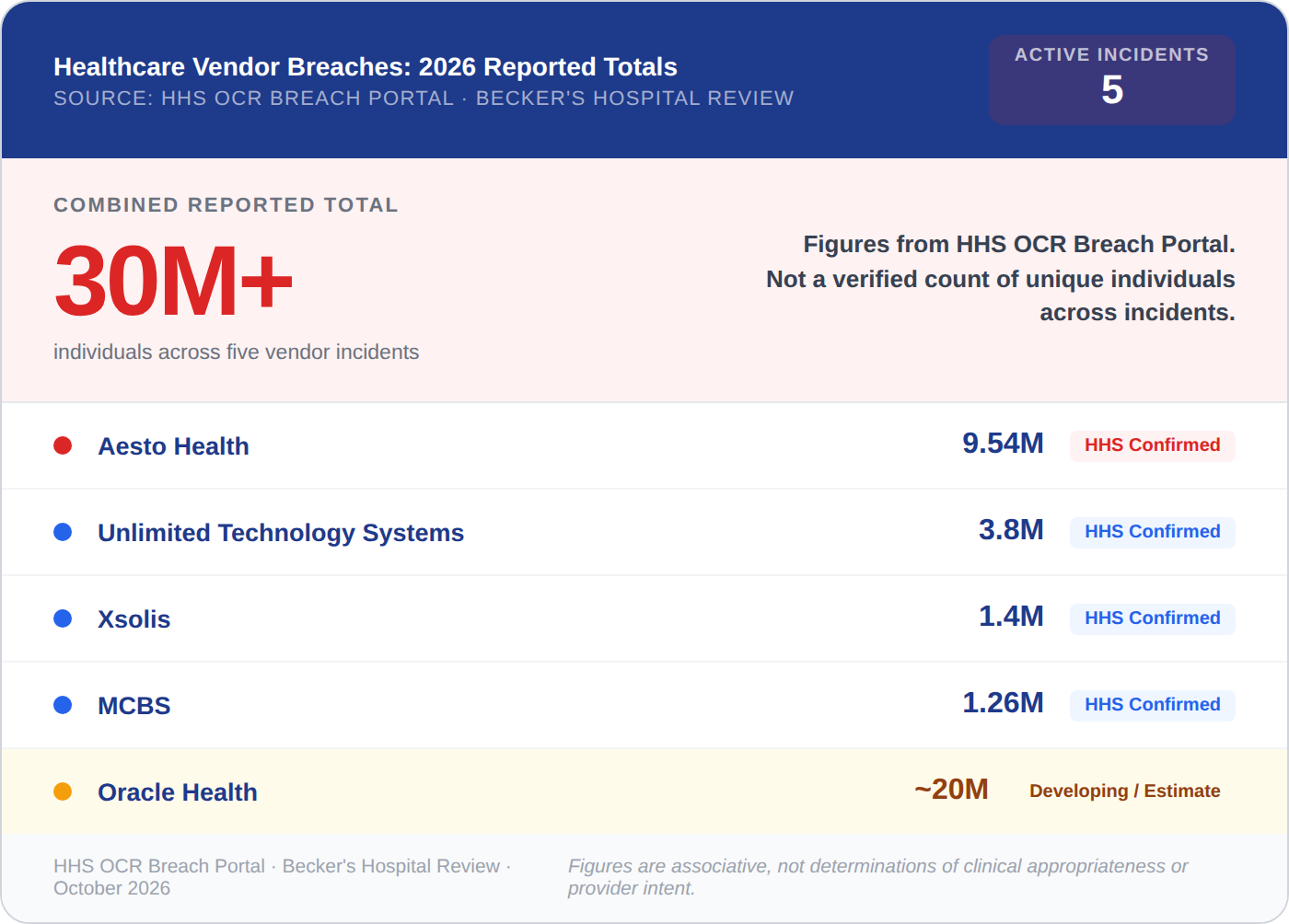
The U.S. Department of Health and Human Services (HHS) Office for Civil Rights breach portal lists the following reported totals from healthcare vendor incidents in 2026:
- Aesto Health: approximately 9.54 million affected individuals
- Unlimited Technology Systems: approximately 3.8 million
- Xsolis: approximately 1.4 million
- MCBS: approximately 1.26 million
The Oracle Health incident is still developing. Becker's Hospital Review reported on the cluster in October 2026. These figures do not represent a verified count of unique individuals across the five incidents, and some individuals may appear in more than one report.
Why It Matters
Each of these incidents is significant on its own. Taken together, they illustrate a structural vulnerability that applies to any organization that relies on third-party vendors for sensitive healthcare operations.
A breach at one vendor does not stay at that vendor. It extends across every healthcare organization that entrusted that vendor with patient data, provider records, or operational access. The five incidents span electronic health record (EHR) infrastructure, cloud services, a hosted platform, an artificial intelligence company, and revenue-cycle management, demonstrating that third-party exposure is not confined to a single technology category or service type.
The question healthcare organizations face is not only whether their vendors have security controls. It is whether they can answer three more specific questions when a breach occurs:
What sensitive information was entrusted to this vendor? Who was authorized to access and use it? And what evidence supports the decisions that were made with it?
Organizations that cannot answer those questions clearly are in a weaker position both operationally and legally, regardless of their own internal security posture.
The Accountability Gap These Incidents Expose
Cybersecurity investments address the likelihood of a breach. Auditability addresses the accountability question that follows one.
When a vendor incident is disclosed, affected organizations are asked to reconstruct what data was exposed, what decisions that data supported, and whether those decisions had appropriate authorization and oversight. In many healthcare workflows, that reconstruction is difficult because the evidence trail was never systematically built in the first place.
The same accountability requirement applies to provider credentialing and compliance, where sensitive information moves across organizational boundaries to establish who is qualified and authorized to deliver care. A payer, regulator, or state licensing board asking an organization to demonstrate that its credentialing decisions were properly evidenced and reviewed is asking the same kind of question a breach investigator would ask: can you show not just that a decision was made, but the evidence, authority, and review behind it?
Auditability is not a substitute for cybersecurity. It is a separate and equally necessary layer of operational accountability.
CareLumi is the trust and verification layer for healthcare AI. Its AI-native platform connects authoritative source evidence, applicable requirements, verification activity, human review, and final decisions across licensing, credentialing, privileging, payer enrollment, and compliance workflows, building a defensible record that organizations can present to payers, regulators, and audit bodies. Third-party review timelines, licensing decisions, and regulatory approvals remain outside any platform's control.
Sources
- U.S. Department of Health and Human Services, Office for Civil Rights: Breach Portal
- Becker's Hospital Review (October 14, 2026): 5 healthcare vendor breaches each affecting more than 1 million people
- State Attorney General Data Security Breach Reports
This alert reflects publicly reported information as of October 16, 2026. Breach totals may be revised as investigations continue.