
What the Court Decided
On July 22, 2025, the U.S. Court of Appeals for the Second Circuit ruled against a New York neurosurgery practice in Neurological Surgery Practice of Long Island, PLLC v. Department of Health & Human Services (HHS).
The practice had filed more than 1,000 claims into the federal Independent Dispute Resolution (IDR) process, a federally managed arbitration system created by the No Surprises Act to resolve payment disputes between out-of-network providers and health plans. Under the Act (signed December 2020, effective January 1, 2022), out-of-network providers can't balance-bill patients directly for protected services. Instead, providers must seek payment from the health plan, and when the two sides can't agree, they go to IDR.
By March 2023, only a couple hundred of the practice's claims had been decided. Facing potential financial collapse, it sued HHS and two other agencies for failing to run the IDR system lawfully. It lost at the district court, and on appeal the Second Circuit affirmed, on grounds that matter far beyond this one case.
Three Reasons Courts Can't Fix the IDR Backlog
The Second Circuit's reasoning is what every practice administrator needs to understand:
The dispute system can be slow, backlogged, and underpowered. A provider bleeding cash because of it has no judicial lever to pull.
The IDR Backlog in Numbers
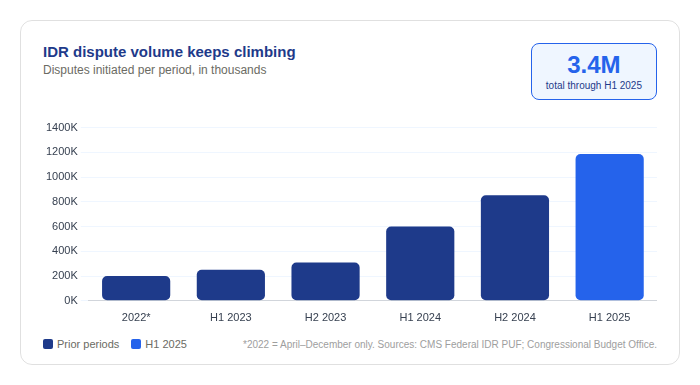
These are figures from CMS Federal IDR reports and the Congressional Budget Office as of mid-2025:
- 3.4 million disputes filed since IDR launched in 2022
- 1.2 million new disputes in just H1 2025, more than double the same period a year earlier
- 400,000+ disputes still unresolved as of mid-2025
- ~Two-thirds of decisions issued past the statutory 30-day deadline
Two structural problems are making this worse. First, the statute has no enforcement mechanism for missed deadlines: miss one and there's often no immediate consequence. Second, a new CMS rule cut the dispute filing fee to $15. Revenue-cycle experts widely expect lower fees to push volume and the backlog higher, not lower.
Researchers have estimated IDR added roughly $5 billion in administrative costs in its first three years alone.
The Only Reliable Protection: Stay In-Network
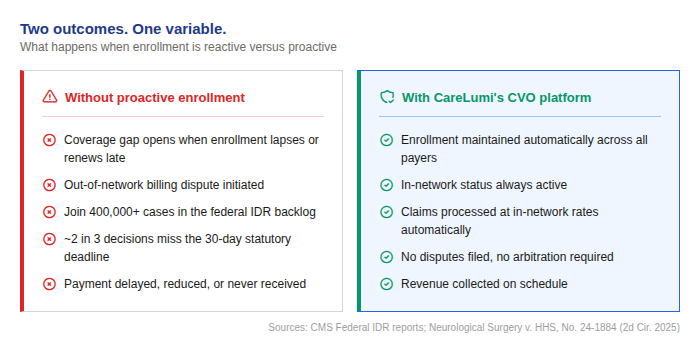
When the dispute process is slow, deadlines are unenforced, and courts have closed the door on relief, fighting harder inside IDR is a losing strategy. The durable protection is structural: stay in-network, so the conditions that trigger a dispute never arise in the first place.
The catch is that network participation isn't a one-time event. It erodes through:
- Lapsed re-credentialing (the periodic process of renewing verified credentials with payers and health systems)
- Missed renewal deadlines
- Unanswered payer information requests
- Coverage gaps when joining new payers or plans
Every one of those gaps is a doorway into out-of-network status and, eventually, into IDR.
How CareLumi Closes the Gap
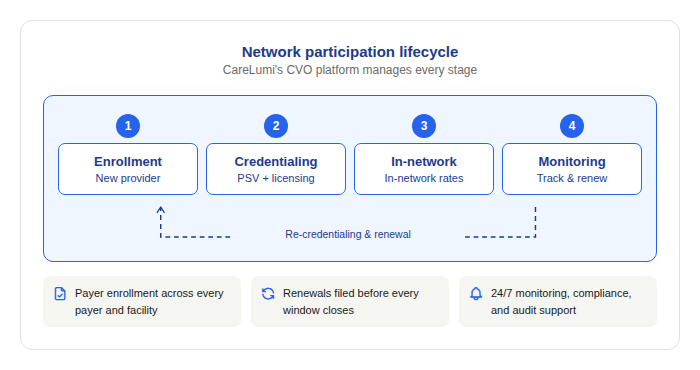
CareLumi automates payer enrollment across every payer, every provider, and physical facilities like diagnostic labs. As a Credentials Verification Organization (CVO), the CareLumi platform covers:
- Primary source verification (PSV): Confirming directly with issuing bodies that a provider's licenses, certifications, and credentials are valid
- Licensing and privileging: Formally authorizing providers to perform specific clinical procedures based on verified training and competency
- Payer enrollment: End-to-end applications when providers want to join new payers or plans
- Renewals and re-credentialing: Every renewal filed before the window closes, so no clerical lapse drops a provider from a network
- 24/7 monitoring, compliance, and audit support
When a payer demands documentation on short notice, the CVO platform responds on time, every time. If a provider stays continuously in-network, claims are processed at in-network rates and the out-of-network scenario that feeds IDR never starts.
Staying Ahead of Regulatory Change
The IDR crisis didn't appear overnight. It was the predictable result of regulations and court rulings stacking up over years. Practices that understood the trajectory early could position around it. Practices that didn't got swept up in it.
CareLumi's CVO platform surfaces regulatory impacts, and the specific actions your practice needs to take, months before they take effect, not after. The recent CMS rule reshaping IDR filing fees is exactly the kind of change that quietly shifts every practice's exposure, and the kind you want flagged well in advance.
The administrative, agency, and payer hurdles aren't going away. The only variable you fully control is whether you're standing inside the dispute process or safely outside it. CareLumi's job is to keep you outside it: prepared, in-network, and paid, no matter how the regulatory environment shifts.