
Key insight: Recent, well-documented failures of general-purpose AI in healthcare are not an argument against using AI. They are an argument for building products where a human, not a disclaimer, stands between an AI output and a high-stakes decision.
Why Trust in AI Is Under Pressure
Recent lawsuits have put a hard question in front of the public: what happens when the AI tool someone leans on for guidance gets a high-stakes call wrong? In a case making headlines, a general-purpose AI chatbot is alleged to have downplayed a user's serious physical symptoms over several weeks, contributing to a near-fatal medical emergency.
The detail that lands is not just the outcome. The chatbot appears to have leaned into the user's own beliefs and reassurances to keep the conversation going, rather than pushing toward care.
This is one of the first cases of its kind: an AI product held to account for advice given in a deeply personal, high-stakes moment. It is exactly the kind of story that makes people pause before trusting AI with anything that touches health or compliance.
Where General-Purpose AI Falls Short in Healthcare
The gap is not about whether AI can be smart. In controlled benchmark comparisons, large language models (LLMs, the class of AI behind general-purpose AI chatbots) have outperformed physicians on diagnostic reasoning tasks.
A broader review of 83 studies found the opposite on average: generative AI performed no better than physicians overall and significantly worse than expert physicians. The difference comes down to setting.
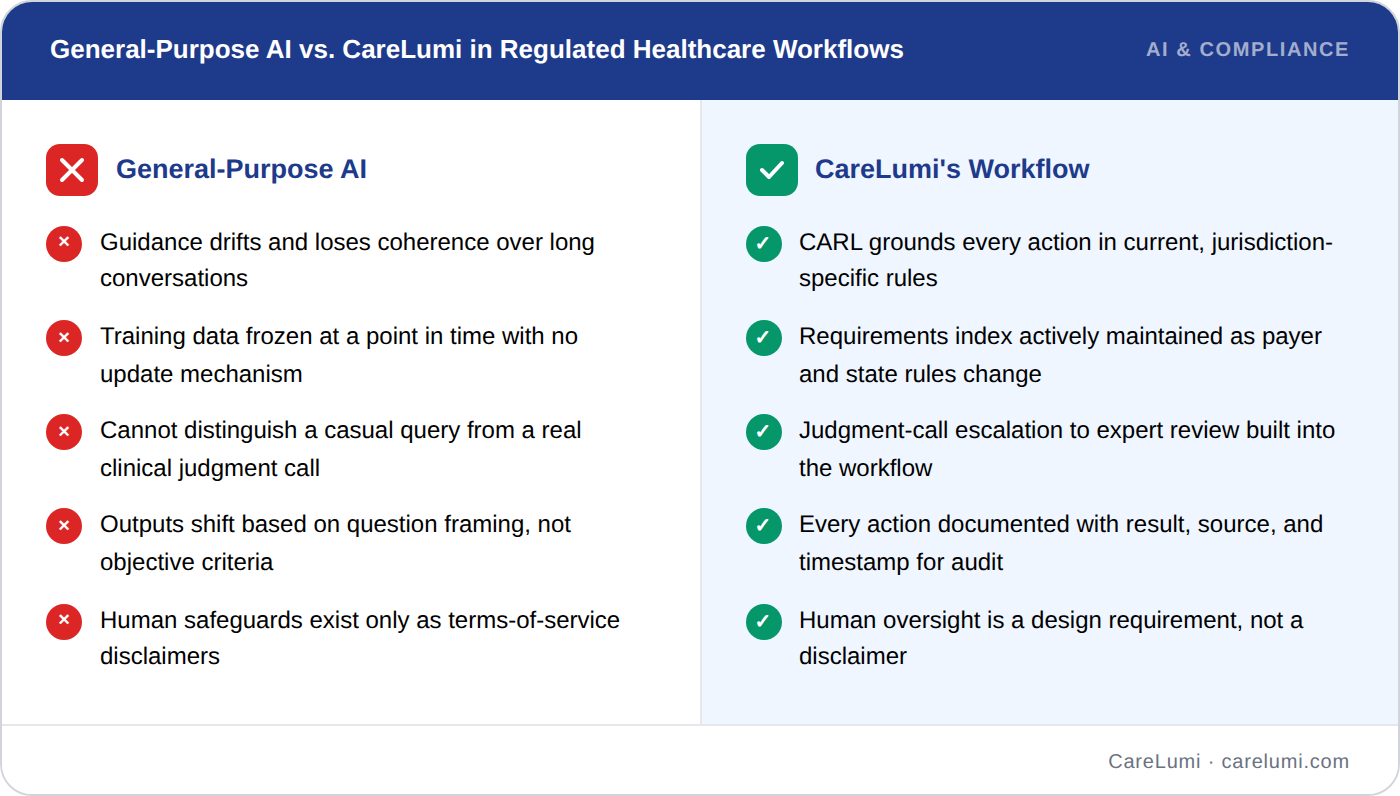
General-purpose tools are not built to track a person's condition consistently over weeks or months. Guidance can drift and lose coherence over a long conversation. They struggle most with ambiguous, overlapping cases that do not map cleanly to training data, which is precisely where healthcare gets messy.
Training data is frozen at a point in time. Even the companies building these models acknowledge that newer versions perform meaningfully better on health tasks than older ones. Currency matters enormously when the stakes are high.
Outputs shift depending on how a question is framed. A general-purpose tool has no reliable way to know when it is being asked for a real clinical judgment versus casual conversation. A 2026 study found that real users relying on LLMs for medical guidance did no better than a control group using their usual methods. In true medical emergencies, an AI health tool under-triaged roughly half of the cases it should have flagged for immediate care.
Why Human Oversight Matters
AI makers are clear that their tools are not meant to replace professional judgment. In practice, people use them that way anyway, because nothing structural stops them.
The gap between how a tool is designed and how it is actually used is the argument for keeping a human in the loop by design, not by disclaimer. A warning in terms of service most do not read does not change behavior in the moment someone needs it to.
This is the core distinction at CareLumi: a disclaimer is not a workflow. Human oversight must be built into how the work actually gets done, not just written into the fine print.
How CareLumi Is Different
CareLumi's agentic solutions are not a general-purpose chatbot repackaged for healthcare. They are built for regulated healthcare workflows, starting with medical credentialing and payer enrollment.
These workflows are high-stakes by definition. A provider's license, certifications, work history, payer requirements, enrollment status, documentation, and eligibility information all need to be accurate, current, reviewable, and defensible. A missed requirement can delay a clinician's ability to practice, interrupt patient access, or create downstream compliance risk.
CareLumi's workflow is designed to include monitoring of AI-assisted actions before, during, and after execution, with every step documented for audit review. Automated credentialing and enrollment steps are structured to be traceable and reviewable, not opaque. Third-party decisions, such as payer approvals and state board determinations, remain outside any platform's control.
CARL: The Knowledge Engine
CareLumi's proprietary solutions are built around an actively maintained index of credentialing requirements across payers, states, and regulatory bodies, updated as requirements change. Unlike general-purpose models drawing on broadly-scraped training data, this architecture reasons from current, jurisdiction-specific rules.
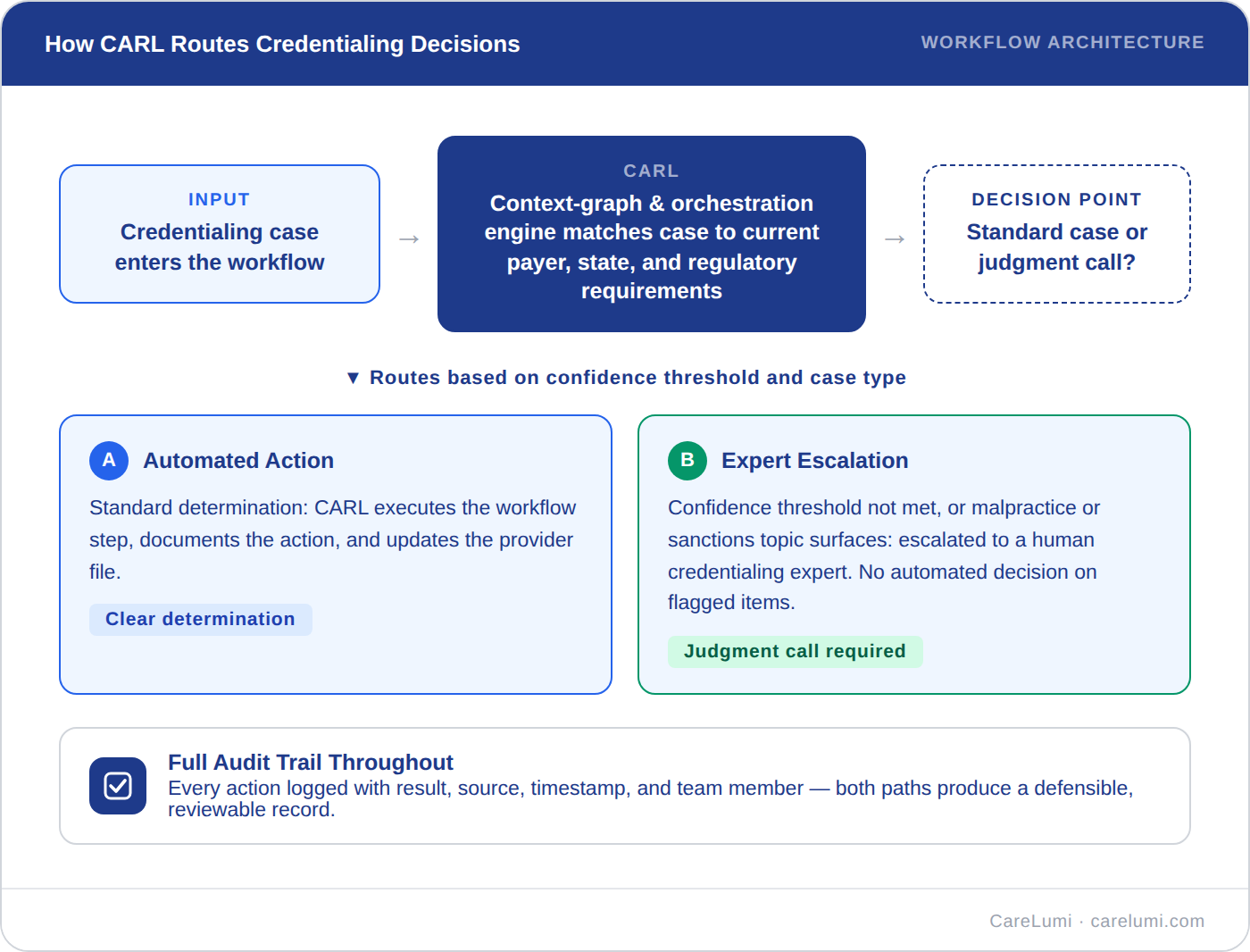
When a case reaches a threshold where the right answer demands human judgment, the platform escalates to expert review rather than generating an approximation.
Credentialing and compliance are not generic knowledge problems. They are evidence, policy, timing, and accountability problems. The right question is rarely “What is a reasonable answer?” It is “What does this organization, payer, state board, or credentialing body require right now, and can we show how we reached this result?”
By grounding every action in current, domain-specific requirements and keeping expert review in the loop for judgment calls, CareLumi reduces the risk that a workflow depends on stale knowledge and treats each case as the specific compliance event it is.
Speed Needs a Safeguard
The goal is to use AI to enhance a workflow, not to let it substitute for the judgment that workflow demands. The problem with deploying general-purpose AI in high-stakes settings is not that a machine processes information quickly. The problem is that the system appears to occupy a role requiring escalation, context, accountability, and human judgment, without the safeguards to deliver them.
AI can make credentialing and payer enrollment faster, more affordable, and more scalable. But it should never blur the line between assistance and authority.
Credentialing Automation That Keeps Compliance at the Center
CareLumi's agentic solutions route every credentialing decision through our proprietary engine, automating routine work while escalating judgment calls to expert review. Built for regulated healthcare, not general-purpose AI.