
Who Verifies Healthcare AI?
New research suggests a clinician reviewing the output may not be enough on its own
Julia Savoia, CareLumi
November 20, 2026 · 4 min read · AI Oversight, Patient Safety
Hospitals have leaned on one safeguard for clinical artificial intelligence (AI): a clinician reviews the output. New research puts that assumption under strain.
What the oversight study found
A randomized controlled study of nearly 50 participants, mostly final-year medical students and resident physicians, tested a simulated AI tool for cardiac auscultation (listening to the heart). Its reliability was lowered in stages, down to complete failure. Diagnostic performance fell along with the tool's reliability, even when participants had to record their own classification before seeing the AI's answer.
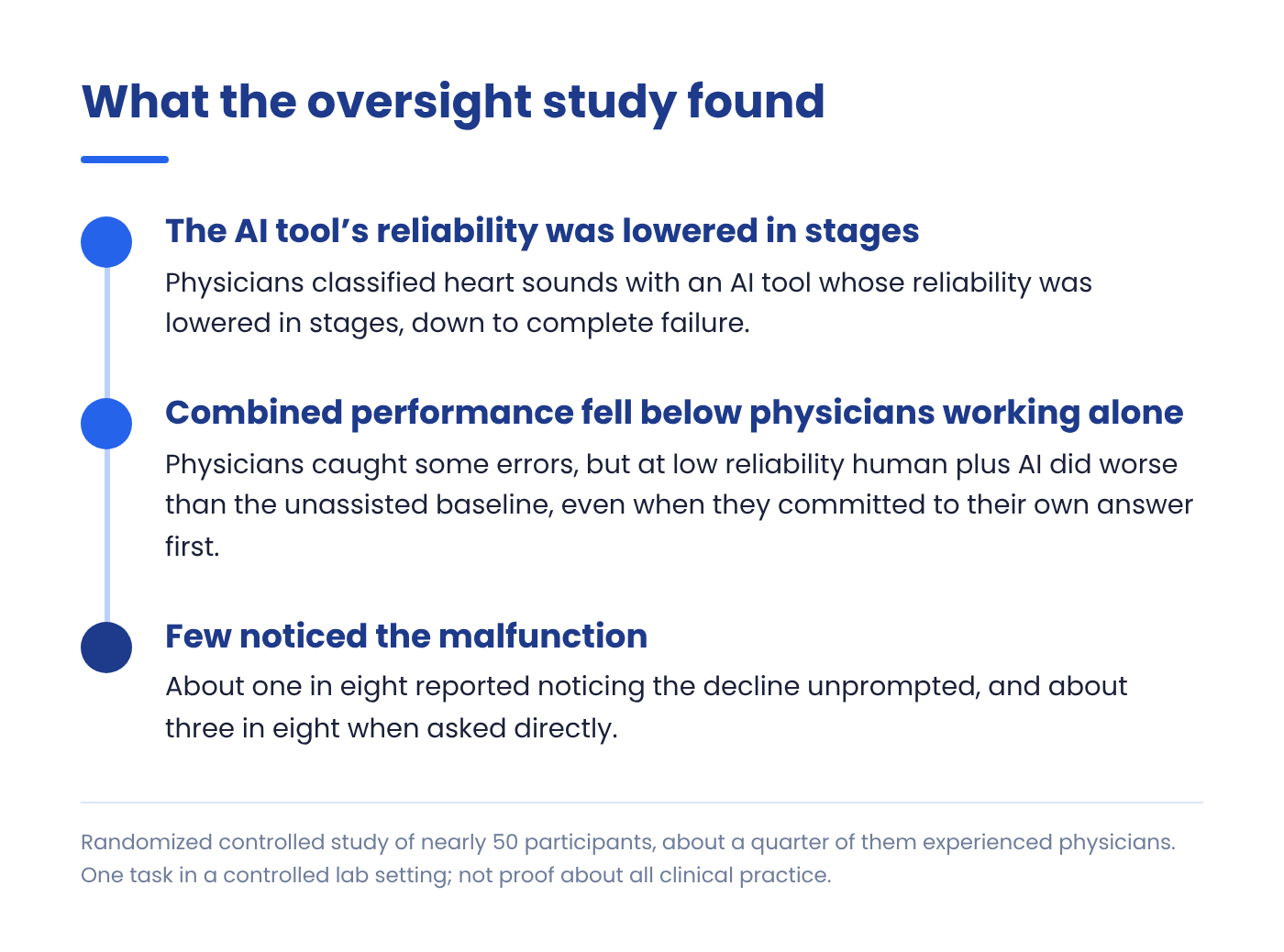
Participants caught some of the errors, but at low reliability their combined performance with the AI fell below their own unassisted baseline. Afterward, about one in eight said they had noticed the decline on their own, and about three in eight when asked directly. Their confidence fell faster than their trust in the AI, which the authors tentatively read as physicians questioning their own judgment before questioning the tool.
The authors call this initial evidence that human oversight alone may be insufficient to catch malfunctions in this setting. They add that real-world fatigue, competing demands and time pressure likely make oversight harder still, and that effective oversight may need action at the system and organizational levels, including shared accountability with the hospitals that deploy AI and the developers who build it. This was a controlled lab experiment on one task, and it should not be read as proof about all clinical practice.
AI performance varies by site
A separate multinational study tested a prostate magnetic resonance imaging (MRI) AI system on more than 22,000 exams from more than 20 countries. Overall, the AI performed comparably to radiologists. Results at individual sites varied: about one in three reached strong accuracy scores, while more than one in four fell below the middle range.
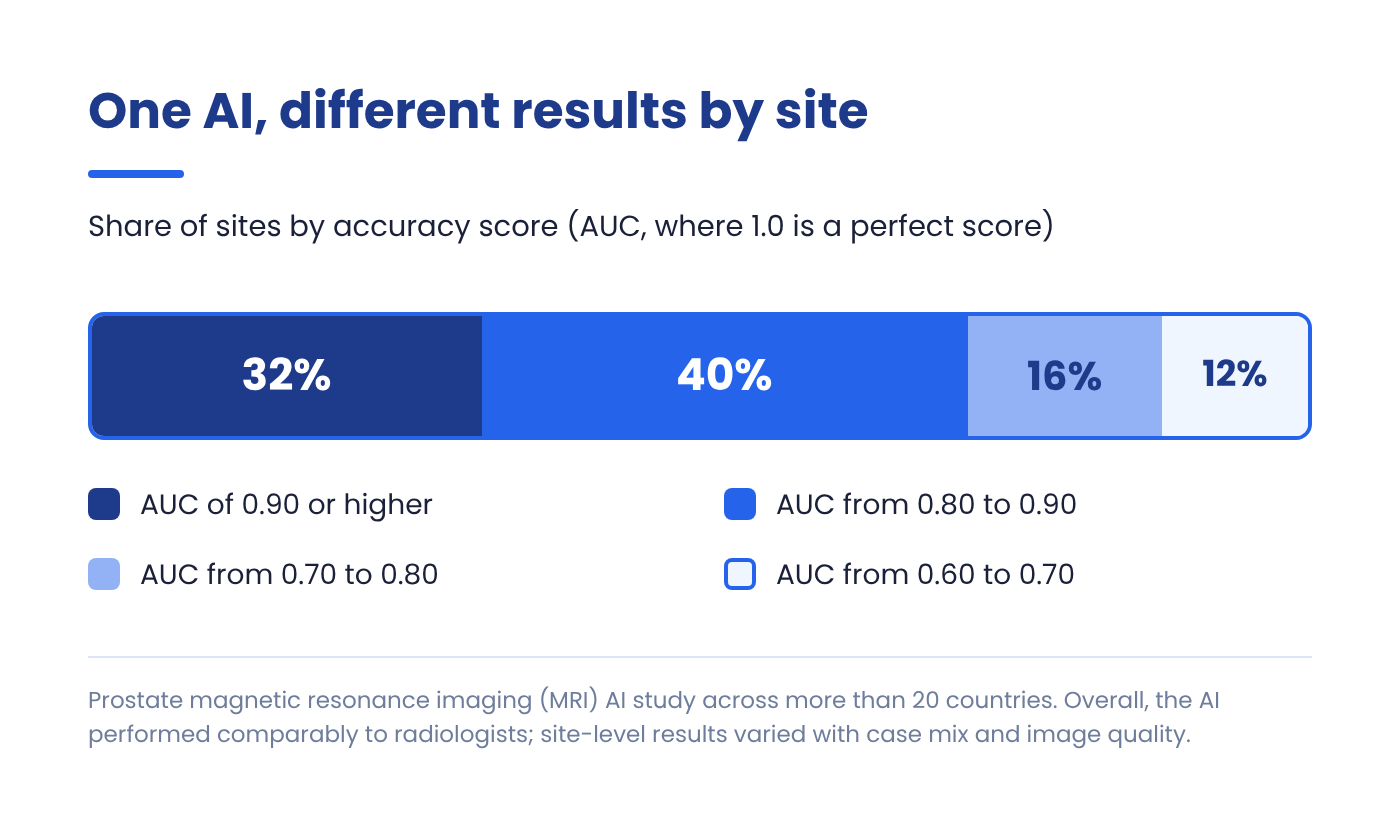
Performance tracked case mix and image quality, and the authors note that shifts in case mix over time can change performance in ways that are not immediately apparent. They call local validation and performance monitoring essential.
What patients expect
A national Gallup survey of adults who had seen a primary care provider in the past year found that 56% are somewhat or very comfortable with AI making diagnosis or treatment decisions when their provider can change or override them. Only 9% are comfortable when AI decides without provider review.
Providers underestimate this comfort. In a separate opt-in survey, 36% of primary care physicians said most of their patients would be comfortable with an overridable AI decision, a 20-point gap.
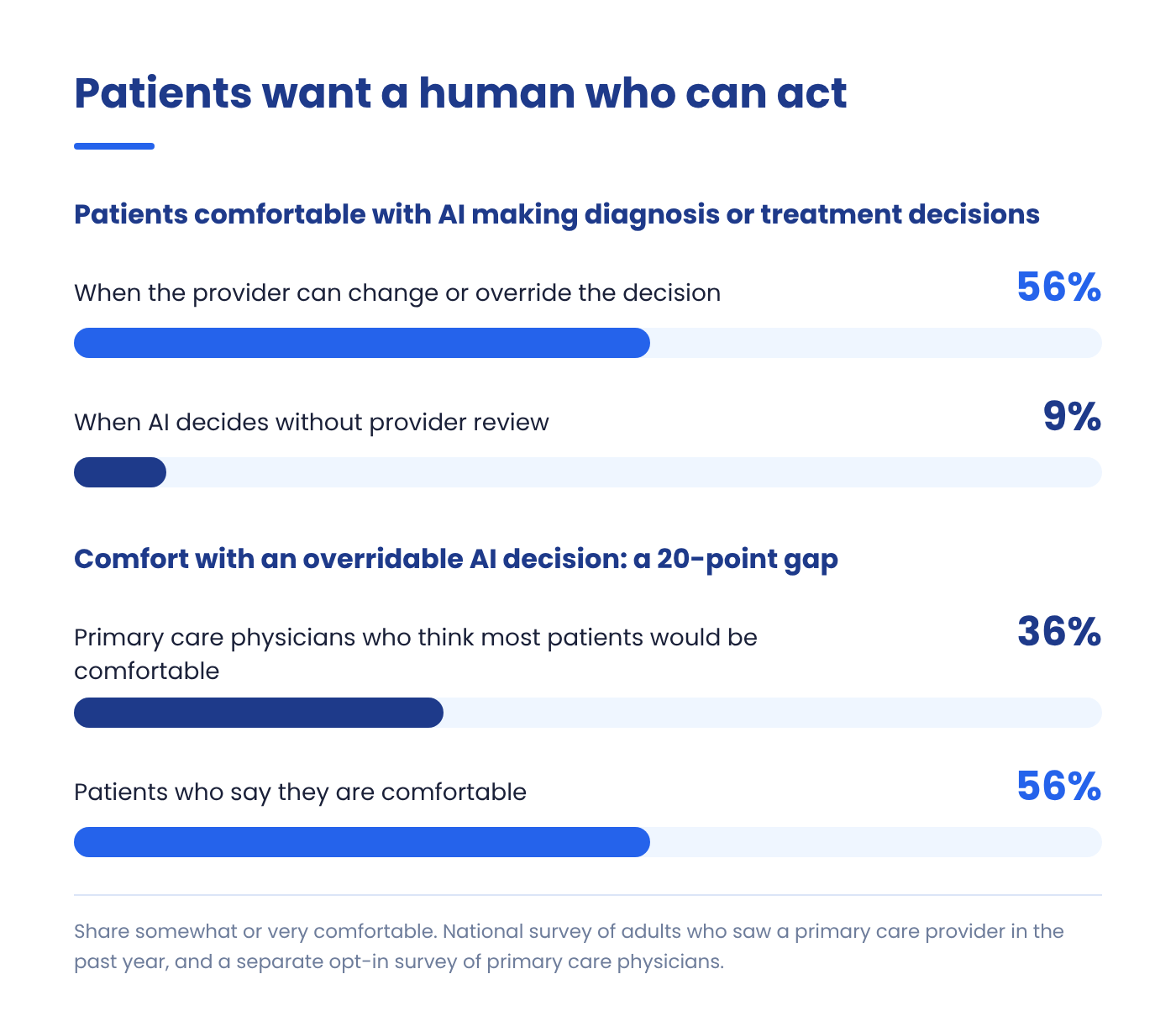
Patients are asking for a human who can act. The oversight study suggests that a human working alone may not see the problem in time.
What health systems need
Many health systems are adopting clinical and administrative AI faster than they can verify it. Checking the work falls to individual clinicians and manual reviewers, which does not scale beyond pilots. Health systems need ongoing assurance that AI stays accurate and safe after deployment, not only during initial testing. When AI makes a mistake, accountability across the clinician, health system and vendor is often unclear, and the burden can land on the individual clinician.
CareLumi is the Verification Layer for Healthcare AI. We audit the AI, automated workflows, and software that healthcare organizations already use across administrative and clinical work, so errors are caught early and responsibility is clear. People stay in charge of every decision, and CareLumi supports them so no clinician is left as the only safeguard.
Who verifies your healthcare AI? Learn how CareLumi supports your team.
Sources
- Challenges for human oversight in detecting system malfunctions in AI-assisted medical diagnostics. npj Digital Medicine.
- Artificial Intelligence for Prostate Cancer Detection and Screening on MRI in Global Populations: The SCARLET-1 Study. Radiology.
- Providers Underestimate Patient Comfort With AI in Care. Gallup.